
Building Resilience to Stress at Midlife and Beyond
/
Declining oestrogen levels heighten sensitivity of the HPA axis…
Read MoreDeclining oestrogen levels heighten sensitivity of the HPA axis…
Read MoreADHD is a neurodevelopmental condition characterised by inattention, hyperactivity, and impulsivity. There are three subtypes of ADHD: Hyperactive, Inattentive and Combined. According to MRI scans taken in 2017 by Gehricke JG et al, the brains of children with ADHD showed smaller brain volumes with the size of specific brain structures reduced. By adulthood, the ADHD brain has mostly normalised in size but not in function. The ‘ADHD brain’ is literally wired differently with complex micro and macrostructures showing smaller amounts of white and grey matter contributing to poor executive function, emotion regulation and attention. Anxiety and depression can be comorbid with ADHD as can Obsessive Compulsive Disorder and Oppositional Defiant Disorder. People with ADHD often experience learning difficulties. The following explains more about the role of specific brain structures and regions and how they differ in ADHD.
Grey and white matter house nerve bodies and axons respectively, signalling across a synapse (a gap between the two). In ADHD there is a delay in signalling, contributing to slower processing.
The Prefrontal Cortex regulates behaviour, emotions and attention. People with ADHD tend towards hyperactivity, inattention and poor decision making do to alterations in circuitry and weaker activation of the Prefrontal Cortex.
The Basal Ganglia responsible for motor learning, also helps regulate behaviour, emotions, and the ability to plan, focus, and multi-task; all of which are dysregulated with ADHD due to inward deformations in the Basal Ganglia resulting in dopamine dysregulation.
The Default Mode Network (DMN) is active when we are at rest enabling daydreaming. In an ADHD brain, the DMN has difficulty switching off. Where normally it would relay messages to the Prefrontal Cortex to switch tasks, in ADHD the process is slower and therefore we can get stuck daydreaming or in mental wandering.
The Limbic System is a set of brain structures including the hippocampus, hypothalamus, amygdala:
The hippocampus is responsible for memory formation and spatial navigation; your ability to know where you are, where you want to go and how you plan to get there. People with ADHD suffer from poor working memory and a poor sense of direction.
The hypothalamus controls the autonomic nervous system and hormone release. People with ADHD can be stuck in sympathetic dominance (fight-flight mode) as the stress hormones cortisol and norepinephrine are dysregulated. They therefore have difficulty managing stress as the Hypothalamic-Pituitary-Adrenal (HPA) axis, responsible for the stress response is dysfunctional. Cortisol is also related to our circadian rhythm which is dysregulated in ADHD causing difficulty getting to sleep and waking up.
The amygdala is the brain’s emotional alarm system. In ADHD it suffers altered connectivity with the prefrontal cortex, the result of which is an overactive amygdala which explains the difficulty in emotional regulation, rejection sensitivity dysphoria and impulsivity.
The thalamus relays sensory signals to the cortex. It can be reduced in volume in people with ADHD causing inattention and difficulty switching tasks, hence our ability to occasionally hyper-focus but comorbid with emotional dysregulation; if you try to drag someone away from a task on which they are hyper focused, they can have an emotional outburst.
It is suggested that as well as genetic mutations caused by certain syndromes, environmental factors like chronic stress during brain development could contribute to underdeveloped brains. Today, more and more research is being done into how Yoga and mindfulness techniques can regulate the autonomic nervous system, support the HPA axis and positively affect specific brain structures and regions. It can be a practical adjunct in the treatment of ADHD.
If you suspect you have ADHD, speaking to other people with the condition can help. There are a number of interesting and validating podcasts I recommend, including ADHD Chatter Podcast on YouTube or Spotify and https://www.adhdwomenswellbeing.co.uk/adhd-podcast
If you want a diagnosis, consult your GP. You can either go on a very long waiting list, or go down the Right to Choose path which can speed things up. Alternatively, you could arrange a private assessment in your area.
The following article may be helpful: https://magazine.medlineplus.gov/article/adhd-across-the-lifespan-what-it-looks-like-in-adults
Why not read A Day in the Life of a Woman with ADHD.
References:
Vogt BA. Cingulate impairments in ADHD: Comorbidities, connections, and treatment. Handb Clin Neurol. 2019;166:297-314. doi: 10.1016/B978-0-444-64196-0.00016-9. PMID: 31731917.
Gehricke JG, Kruggel F, Thampipop T, Alejo SD, Tatos E, Fallon J, Muftuler LT. The brain anatomy of attention-deficit/hyperactivity disorder in young adults - a magnetic resonance imaging study. PLoS One. 2017 Apr 13;12(4):e0175433. doi: 10.1371/journal.pone.0175433. PMID: 28406942; PMCID: PMC5391018.
Gonzalez NA, Sakhamuri N, Athiyaman S, Randhi B, Gutlapalli SD, Pu J, Zaidi MF, Patel M, Atluri LM, Arcia Franchini AP. A Systematic Review of Yoga and Meditation for Attention-Deficit/Hyperactivity Disorder in Children. Cureus. 2023 Mar 14;15(3):e36143. doi: 10.7759/cureus.36143. PMID: 37065343; PMCID: PMC10101238.
Winke Francx, Alberto Llera, Maarten Mennes, Marcel P. Zwiers, Stephen V. Faraone, Jaap Oosterlaan, Dirk Heslenfeld, Pieter J. Hoekstra, Catharina A. Hartman, Barbara Franke, Jan K. Buitelaar, Christian F. Beckmann,
Arnsten AF. The Emerging Neurobiology of Attention Deficit Hyperactivity Disorder: The Key Role of the Prefrontal Association Cortex. J Pediatr. 2009 May 1;154(5):I-S43. doi: 10.1016/j.jpeds.2009.01.018. PMID: 20596295; PMCID: PMC2894421.Integrated analysis of gray and white matter alterations in attention-deficit/hyperactivity disorder, https://doi.org/10.1016/j.nicl.2016.03.005.
Sobel LJ, Bansal R, Maia TV, Sanchez J, Mazzone L, Durkin K, Liu J, Hao X, Ivanov I, Miller A, Greenhill LL, Peterson BS. Basal ganglia surface morphology and the effects of stimulant medications in youth with attention deficit hyperactivity disorder. Am J Psychiatry. 2010 Aug;167(8):977-86. doi: 10.1176/appi.ajp.2010.09091259. Epub 2010 Jul 1. PMID: 20595414; PMCID: PMC4254769.
Luu B and Fabiano N (2025) ADHD as a circadian rhythm disorder: evidence and implications for chronotherapy. Front. Psychiatry 16:1697900. doi: 10.3389/fpsyt.2025.1697900
Onnink AM, Zwiers MP, Hoogman M, Mostert JC, Dammers J, Kan CC, Vasquez AA, Schene AH, Buitelaar J, Franke B. Deviant white matter structure in adults with attention-deficit/hyperactivity disorder points to aberrant myelination and affects neuropsychological performance. Prog Neuropsychopharmacol Biol Psychiatry. 2015 Dec 3;63:14-22. doi: 10.1016/j.pnpbp.2015.04.008. Epub 2015 May 5. PMID: 25956761; PMCID: PMC4515357.
Stevens MC, Haney-Caron E. Comparison of brain volume abnormalities between ADHD and conduct disorder in adolescence. J Psychiatry Neurosci. 2012 Nov;37(6):389-98. doi: 10.1503/jpn.110148. PMID: 22663946; PMCID: PMC3493096.
(https://www.sciencedirect.com/science/article/pii/S2213158216300468)https://www.davidsongifted.org/gifted-blog/understanding-diagnosing-and-coping-with-slow-processing-speed/
https://chadd.org/attention-article/managing-inattentive-adhd-with-psychosocial-treatments/
https://chadd.org/attention-article/mindfulness-meditation-and-yoga-as-treatments-for-adhd/
https://my.clevelandclinic.org/health/body/limbic-system
It’s a cliche but Yoga is a journey; one that has the power to change with you.
Read More…we can all benefit from adopting skills that help us manage stress.
Read MoreIt’s a cliche but Yoga is a journey; one that has the power to change with you.
Read MoreI know how important it is that I prioritise myself
Read MoreTaking a full sabbatical from work is a luxury few of us can afford. But how about taking a sabbatical from pressure?
I’ve realised that expecting too much of myself causes me to suffer and burn out. When I allow perfectionism to dominate, nothing is good enough, and am my own worst critic. But I am the one putting pressure on myself, allowing the ‘shoulds’ to govern me.
So why do we pressure ourselves? Is it because we want recognition? Perhaps we want to do better, be the best, crave attention, want the next best thing, long for, lust after, covet, yearn. Do these actions make us happy? The things that really make us happy are those that fulfil our human needs: friends, family, community, health, nourishment, sleep, shelter, safety, enough wealth to survive and a little more to thrive. Enough.
When we feel stressed, it is often our own expectations getting in the way; the pressure we pile onto ourselves. We could be our own best friend instead of our own worst enemy. What would you do if your best friend told you they felt pressured and that it was making them sick? What advice would you give? Make a list and see what comes up as you read it through.
Here are some ideas I’ve had while taking a pressure sabbatical:
Stepping away from social media. I’m not missing out on life because life’s right here… now.
I’ve learned that I don’t have to make an excuse or give a reason when saying NO.
I’m only doing the bare minimum.
I’ve let perfectionism go. Enough is good enough.
I step away as soon as I begin to feel overwhelmed. Space brings perspective. Time spent in nature soothes our nervous system so I feel even better for a walk.
I am easily bored so instead of pressuring myself to focus on just one job, I have a few on the go at once. When I start to feel dullness or boredom, I switch jobs. This has been a revelation to me because I actually get more done!
I have learned to ask for help and accept it when offered. Pride doesn’t get me anywhere.
Timetabling is great for brain fog! it means I can tick off the jobs!
Regular rest breaks are essential. Pushing on is pushing into burn out. Rest can be 3 minutes of pranayama, a little weeding, movement of any kind.
Remember, as Brene Brown says, “you are always doing the best you can,” so why pressure yourself to do more?
Leave a comment if you have any good ideas for easing pressure.
Stress comes in many guises so it’s important to understand what might trigger symptoms.
Read MoreIf I could use one word to describe the way I’ve been feeling lately, it would be discombobulated. It’s been two years since we were in full lockdown in the UK. Life has changed for us all and whether we know it or not, it’s affected us on a tissue level. The fear, anxiety and stress went deep because we had to brace ourselves and now we’re living with constant uncertainty from the virus, the economy, the climate and the war in Ukraine.
I didn’t realise until my back went into spasm, just how much I had been holding on; quite literally bracing myself. I leapt from one crisis to another - the pandemic, the death of my father in law, the stress of starting a new course, deadlines and learning difficulties, keeping my business afloat and family issues; it all led to my becoming dissociated from myself.
I had known I needed to put the breaks on. I needed to stop, recentre and ground myself. I needed to feel what was happening on the inside, but my course exams were looming and I kept saying “not yet.” So my body floored me! That’s how it works energetically. “Now you’re listening aren’t you,” it said.
It’s been a humbling experience, not least because I know that what I do (or rather, don’t do) affects others. As Brene Brown would put it, I’ve been doing my best. And as I type this, the little gremlin in the back of my mind just said, “Yes, but your best isn’t good enough is it?” My job now is to silence that gremlin with kindness and self compassion.
The tools I learnt studying Yoga Therapy for the Mind will help me. As I say to my clients who take the De-Stress your Mid-Life course, these tools are life long skills that we will return to over and over again. To be human is to be fallible. But the most important thing is that we learn from our mistakes. And my mistake was not prioritising self care.
So lessons learned are:
Doing your best is good enough.
Taking time every day for self care is not selfish, but invaluable.
Celebrate every success, no matter how small.
Ask for help when you need it.
The boys are capable of looking after themselves, so let them!
I hope in some way, you resonate with some of this and find it useful to hear my story.
Have you been for your mid-life health check recently? Many women at this time of life are diagnosed with high cholesterol. There’s good reason for this and it’s important to understand why.
Cholesterol is manufactured in the liver. It is responsible for repairing damaged tissue. Steroid hormones such as oestrogen, progesterone and cortisol are derived from cholesterol. As oestrogen levels are lowering at mid-life, it is not unlikely that we will have raised levels of cholesterol which is more of a problem in conjunction with high blood pressure, diabetes, obesity or a genetic tendency to gain weight around the middle.
Cortisol is one of our stress hormones and its main role is to modulate inflammation. The body is unable to metabolise the amount of cortisol circulating when chronically stressed. Cortisol then becomes dysfunctional and the result is actually increased inflammation. Not only is cholesterol needed for greater cortisol production but also to repair any damage to the tissues as a result of inflammation.
Food intolerances are inflammatory and are common in women at mid-life. Arthritis and rheumatism are inflammatory conditions also. Higher levels of cholesterol is necessary for the body to derive cortisol whose role is to modulate inflammation in these circumstances. Remember that cortisol is our friend until it gets out of control.
Stress is often the root cause of dis-ease and disease and this certainly needs to be addressed. Downregulating an overactive nervous system and developing skills to manage stress can reduce cortisol and thereby lower cholesterol.
If like me, you prefer to find a natural solution before going down a medical road, consider whether there is a source of inflammation that could be the cause of high cholesterol. Address that and you may find your cholesterol levels lower. It is important to get them checked again to take a different course of action should it be sensible or necessary.
References:
https://www.uscjournal.com/articles/menopause-cholesterol-and-cardiovascular-disease-0#:~:text=Menopause%20is%20associated%20with%20a,%2Ddensity%20lipoprotein%20(HDL).
https://www.health.harvard.edu/heart-health/how-its-made-cholesterol-production-in-your-body
https://www.ncbi.nlm.nih.gov/pmc/articles/PMC4263906/#:~:text=Cortisol%20is%20a%20potent%20anti,survival%20and%20avoidance%20of%20danger.
Acute stress, chronic stress and burnout are three separate states of stress. It’s important to know what they are so you know how to respond.
Read MoreI was so impressed by the body’s ability to rest when supported in the right way,
Read MoreOur ability to adapt to different situations depends very much on the individual. Some of us have a sensitive nervous system that requires nurturing. Others are more robust. The condition of our nervous system is determined to a degree by how stressed our mother was when we were in vitro but is also down to the amount of trauma and stress we have experienced in our life.
When we encounter a stressor, every system in our body responds. In order to return to a state of equilibrium (homeostasis), the nervous and endocrine systems have to adapt. We can help our internal recovery along by building mental strength and flexibility. Having a better understanding of ourselves promotes adaptability.
Write a list of circumstances which make you feel uncomfortable such as confrontation, being in a crowded space, driving on the motorway, meeting new people etc... Nothing triggering. As you write each one down, pause and notice how you feel in your body. What are the sensations? Where are they felt? Notice and be curious. Try not to analyse or push them away.
Now visualise the same scenarios differently:
Breathe deep down into your belly.
See yourself with your shoulders rolled back, your chest open and your head straight.
Clench your fists gently. Does that help you to feel more powerful? If it fuels anger, instead of pushing it away, notice where you feel it and how?
Feel your feet on the ground and ‘root’ down.
What other physical posture could you take?
Make a positive affirmation such as, ‘I can do this’, or ‘I’ve got this.’
Write down how you feel. Check in with your mind, body and breath. You may find it helpful to practice this visualisation before every situation with which you are uncomfortable.
Low level stress actually helps us to adapt. Each time we cope with an uncomfortable situation, we feel empowered and become more resilient physiologically and mentally. To strengthen your ability to adapt:
Step out of your comfort zone regularly.
Notice, change and notice the change.
Remember that thoughts are not facts.
Never base your present fears on past experience; no two situations are the same.
Be prepared to bend your own rules be more flexible; your way isn’t the only way.
Acceptance empowers you.
Do not allow failure to stop you. We learn from our mistakes.
Here are some other tools which you may find helpful:
Slow down - taking life at a slower pace allows us be aware of our experience and to recuperate from the challenges.
Keep a journal - writing down our feelings helps put things into perspective.
Practice gratitude - the brain has a negativity bias so force yourself to recollect the positives.
Spend time in nature regularly; it is proven to calm and ground us.
If you feel you need some support on your journey, I’m here to help. Why not book a Clarity Call and we can chat confidentially about how to take you forwards.
One of the best things about Yoga is becoming more self aware. But is it possible to become too self aware? Self awareness can sometimes be perceived as narcissism. I think there are levels of self awareness, with disassociation at one end and narcissism at the other. In the middle is a healthy balance. So how do you get there?
Disassociation is common when you have spent your life trying to avoid painful feelings; likely from a traumatic experience or chronic stress. The brain’s way of protecting you from the pain is to keep the body in freeze mode and prevent you from feeling. To move beyond this may require talking therapy but at some point we need to connect with the physical feelings in the body. The process can be slow and disquieting but with safety measures in place, the end result is knowing yourself, understanding what these feelings mean and being resourced with skills to manage overwhelm and restore homeostasis.
If we navigate this road mindfully, we can find that middle ground. We can recognise what the body and mind require before it becomes overwhelming and if it does (which it will; life has a way of throwing us a curve ball sometimes), we can learn to be with the experience, not to resist it.
We move into narcissism when we over analyse; spend too much time wondering why we experience one feeling or another and endlessly talking about it. It’s a bit like googling every symptom you have and believing you are ill; the modern form of hypochondria and it’s boring for everyone around you. I know, I’ve been there! And you might too if you’ve been mentally unwell. It’s part of the natural process of getting to know yourself again. The important thing is recognising when to back off and return to the middle ground.
The beauty of being self aware is in the wisdom of the body. When you stay present to your experience, the body will guide you. When I get on my mat, I let my body and my energy guide me to where it needs to go. With support, time and practice, you can too. It’s an amazing place to be and very rewarding too!
…it isn’t just gardening that benefits our mind and body, nature has the same effect.
Read MoreAt the risk of repeating myself… This is so important!
When we are adjusting to the hormone changes in our body, stress becomes more of a burden than we realise. Why? Because the adrenal glands are responsible for secreting stress hormones. But they are also responsible for mimicking oestrogen by creating oestrone. So while the adrenals are busy trying to maintain homeostasis for our endocrine system, they cannot cope with stress.
Have you noticed that if you get stressed, you burn out more easily?
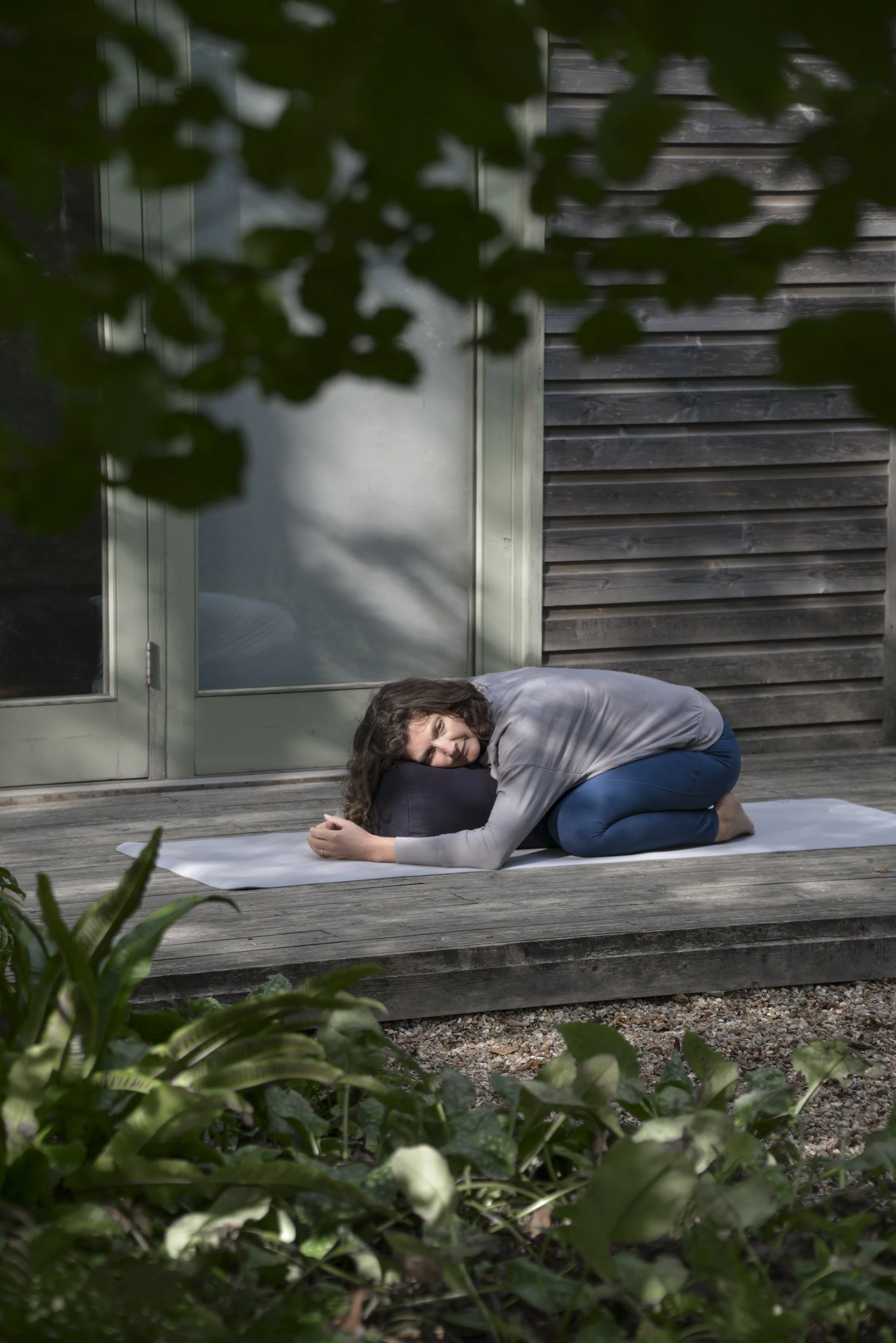
What can you do about it? Restorative Yoga! Seriously, it has the most astonishing effect on the body. By propping yourself in such a way that your body is supported; held safely and securely, your nervous system can relax.
If you were to practice a restorative pose every day, you would cope better with stress. Why not have a one to one to learn 3 poses to suit your lifestyle so that you can practice something every day?
Warning, this article may be triggering if you have suffered a sexual assault.
Read More…it’s the measure of the variation in time between heartbeats.
Read MoreThe more we dampen our stress hormones, the easier it is to sleep.
Read MoreFind out more about the De-stress Your Mid-life course.
Yoga classes, courses and workshops led by qualified yoga teacher Anneliese Wells. Taught in a beautiful, rural, private studio in Barcombe, East Sussex.